If you are an HR manager in India right now, let me guess your week: you reviewed 400 resumes, shortlisted ten, interviewed four, rolled out two offers, and watched your top pick vanish into a 90-day notice period black hole.
Hiring tech talent in India can feel like trying to catch Wi-Fi in a basement. As someone who tracks talent markets closely, I know how exhausting it is when hiring managers demand a "10x full-stack AI ninja with 8 years of experience in a 3-year-old framework" on a fresher's budget. Let’s take a breath, grab some chai, and look at the exact recruitment and talent solutions you need to win without losing your sanity.
"Acquiring the right talent is the most important key to growth. Hiring was—and still is—the most important thing we do." — Marc Benioff
1. Real-Time Recruitment Intelligence: What the Data Tells Us
Before you spend a single rupee on job boards, you need sharp recruitment intelligence. In India, technology is once again leading compensation growth across experience bands, with mid-level specialists acting as the fiercest battleground. Meanwhile, Tier-2 innovation hubs like Pune, Jaipur, and Kochi are booming with senior and mid-management talent.
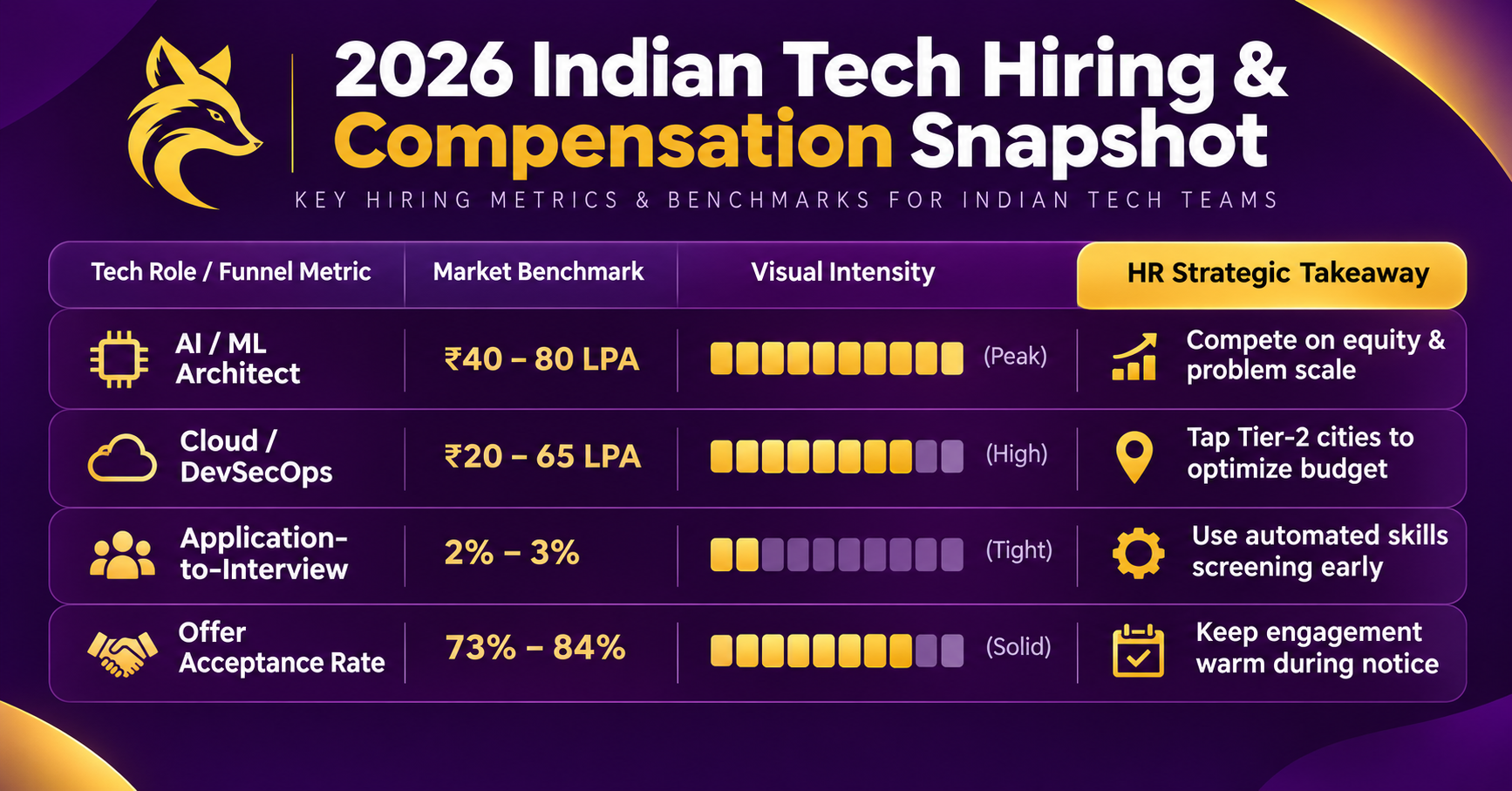
Here is the real-time reality check you need when benchmarking salary trends, time-to-hire, and cost-per-hire:
1. Recruitment Intelligence: What Real-Time 2026 Data Tells Us
Before you post another job opening, look at what is actually happening on the ground. India’s tech hiring has shifted from mass volume to razor-sharp capability. Global Capability Centres (GCCs) are outpacing traditional IT firms with 15–25% salary premiums, while Tier-2 hubs like Thane, Kochi, and Coimbatore are emerging as serious leadership ecosystems where senior tech pay averages ₹28.38 LPA.
Meanwhile, candidates switching jobs in India are asking for a 44% median salary hike. Look at how wildly expectations vary across roles right now:
If your budget is capped at a rigid 20% hike for an AI or DevOps role, your time-to-hire will balloon while your cost-per-hire bleeds money on endless re-sourcing. You can track more real-time benchmarks like these on our VibeShifter insights hub.
2. Smarter Hiring & Future-of-Work Workflows
Ditch Degree Pedigree for Skills-Based Hiring
One of the biggest hiring mistakes I still see HR teams make is copying and pasting bloated job descriptions demanding elite college degrees and buzzword soup. Roughly 60% of Indian tech employers have already dropped strict degree requirements in favor of skills-based hiring.
Instead of filtering resumes by college name, judge candidates on GitHub repositories, live coding sandboxes, and real architectural problem-solving. Your interview strategies should test how a candidate thinks under constraints—not whether they memorized textbook definitions.
Pair AI in Recruitment with Gen Z & Hybrid Realities
AI-powered screening and skill-adjacency matching can cut your initial resume screening time in half. Let automation handle scheduling and skill parsing so you can focus on human connection.
And remember who you are hiring: the Gen Z workforce values transparency, rapid upskilling, and autonomy. With 80% of companies offering hybrid models, forcing a five-day office commute for a cloud role that can be done from anywhere is the fastest way to shrink your talent pool.
3. Don’t Forget Tech-Adjacent Sales Hiring
Here is a truth tech founders often overlook: the cleanest code in the world won’t pay salaries if nobody sells it. As an HR leader, building balanced teams means aligning engineering with strong sales hiring.
When recruiting SaaS sales executives or tackling BDE recruitment, skip clichés like "Sell me this pen." Use consultative sales interview questions instead:
- "Walk me through a deal you lost after three months—what did you miss?"
- "How do you explain a complex API product to a non-technical CFO?"
Great tech sales teams thrive when HR builds clear commission structures and pairs BDEs with product engineers early in onboarding.
4. Fixing Retention Before Day 90 Hits
HR Reality Check: Why did the full-stack developer cross the road? Because another recruiter offered a 50% hike and permanent remote work on LinkedIn before he finished crossing.
Winning the signature is only half the battle. High employee turnover happens when there is a gap between what you promised in the interview and what the engineer experiences on Monday morning.
To master first-90-day retention and employee engagement:
- Warm up the notice period: Indian notice periods run 60–90 days. Weekly check-ins, swag kits, and team introductions stop offer shopping before it starts.
- Structure Week 1: Assign a dedicated engineering buddy and ensure laptops, repo access, and sprint goals are ready on Day 1.
- Run a 45-day pulse check: Ask new hires what feels broken while there is still time to fix it.
How to Solve This Problem
You don’t have to carry this entire funnel on your shoulders alone. Modern HR managers combine internal employer branding with specialized external talent solutions:
- On-Demand Talent Partners: Working with curated talent networks like VibeShifter
gives you pre-vetted, skills-assessed tech and sales professionals without wading through 500 irrelevant resumes.
- Flexible Hiring Models: Blend full-time core hires with contract-to-hire specialists for urgent cloud or AI sprints.
- Streamlined Pipelines: Explore dedicated VibeShifter recruitment solutions
and see how it works to compress your hiring cycle from months to days.
Your Tech Hiring Action Plan, Checklist & Next Steps
30-Day Action Plan
- Week 1: Audit your open job descriptions—strip out degree mandates and clarify salary bands upfront.
- Week 2: Cap your interview loop at three focused rounds (Technical Practical, System Design, Culture/Leadership) completed within 10 business days.
- Week 3: Launch a notice-period engagement cadence for every offered candidate.
- Week 4: Partner with specialized tech recruiters for niche AI, cloud, and BDE roles.
Quick HR Tech-Hiring Checklist
- [ ] Salary bands benchmarked against 2026 Tier-1/Tier-2 market data
- [ ] Skills-based practical test replacing generic résumé filtering
- [ ] Hybrid/remote policy clearly stated in the job post
- [ ] Notice-period engagement calendar active for offered candidates
- [ ] 30-60-90 day onboarding roadmap shared with hiring managers
Measurable Next Steps
Track these three metrics over your next quarter to prove ROI to leadership:
- Offer-to-Join Ratio: Aim for 85% or higher through faster loops and warm notice-period engagement.
- Time-to-Hire: Bring tech roles under 28 days from requisition to offer.
- First-90-Day Retention: Target 95%+ retention across new tech and sales hires.
Ready to Build Your Dream Team (or Land Your Next Role)?
Hiring great tech talent in India doesn’t have to feel like chasing shadows. Whether you are a growing company scaling your engineering and sales teams or a talented professional ready for your next big leap, VibeShifter bridges the gap with speed, transparency, and human-first matching.
👉 Take the next step today: Submit your profile to get hired by top innovators, or request talent for your hiring needs. We'll reach out privately to understand your requirements and connect suitable opportunities with the right people.